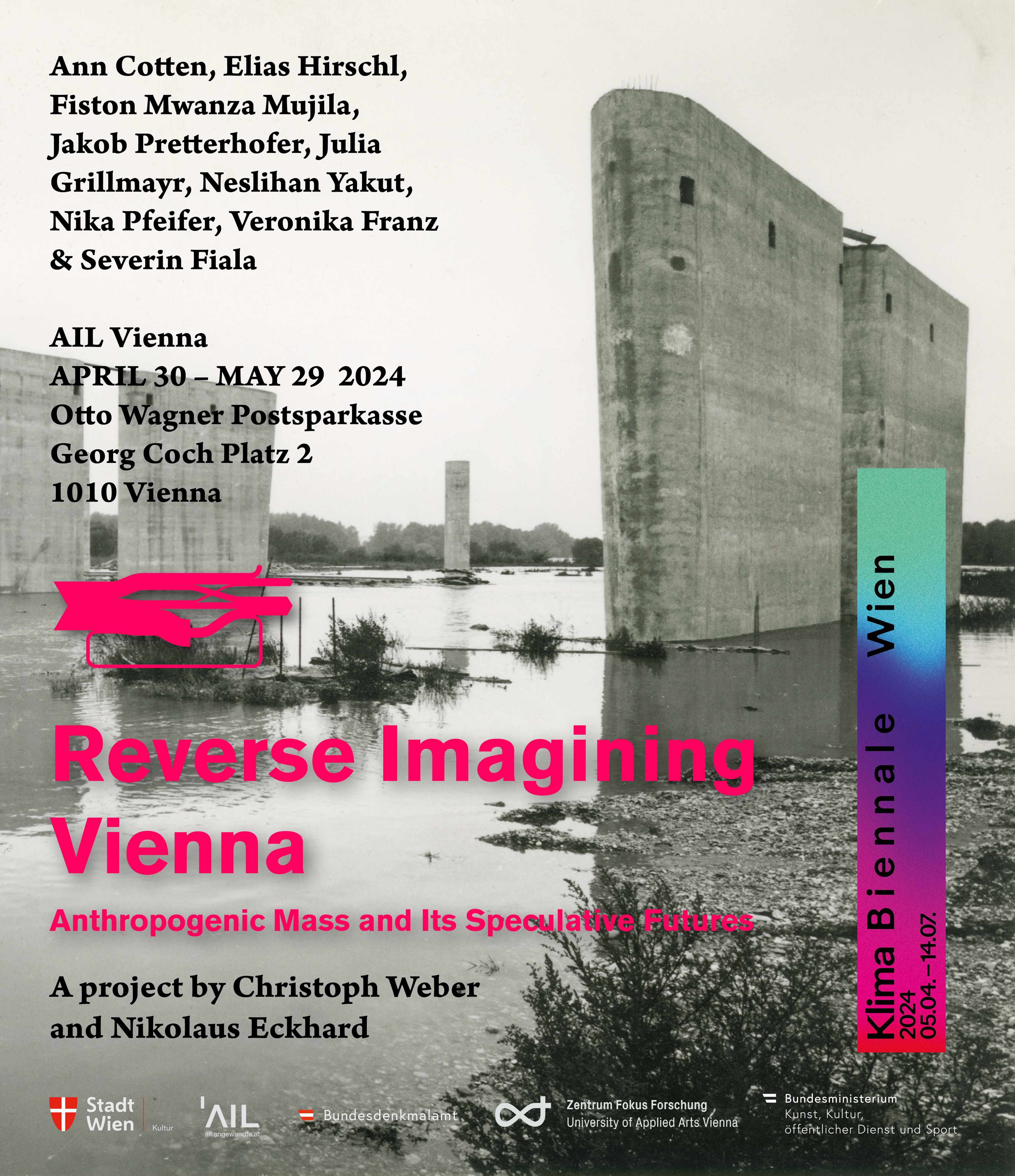
Exhibition views: Klima Biennale 2024 exhibition: Reverse Imagining Vienna, AIL Vienna
https://ail.angewandte.at/explore/exhibition-view-reverse-imagining-vienna
Since 2020, the global stock of human-made mass has exceeded the total sum of biomass on Earth – around 90 percent of which is building materials. In the project Reverse Imagining Vienna, two sculptors and nine writers took a Viennese Gründerzeit building and the Prater Bridge, which crosses over the Danube, as material and speculative anchors in which to gain perspectives on sustainable relationships with inanimate matter. Referring to so-called reverse engineering, the two structures were deconstructed and recomposed in a historical, material-analytical, poetic and visionary way. Developing Reverse Imagining as research method, the project was based on dossiers about present and historical facts of the main building materials, imagining different futures from the present to geological antiquity. Eight speculative short prose pieces react to the two research objects in four given futures. 2050, 2500, 12000, and 15 milion years in the future. Sculptures by Weber & Eckhard, in turn, react to the texts and the objects.
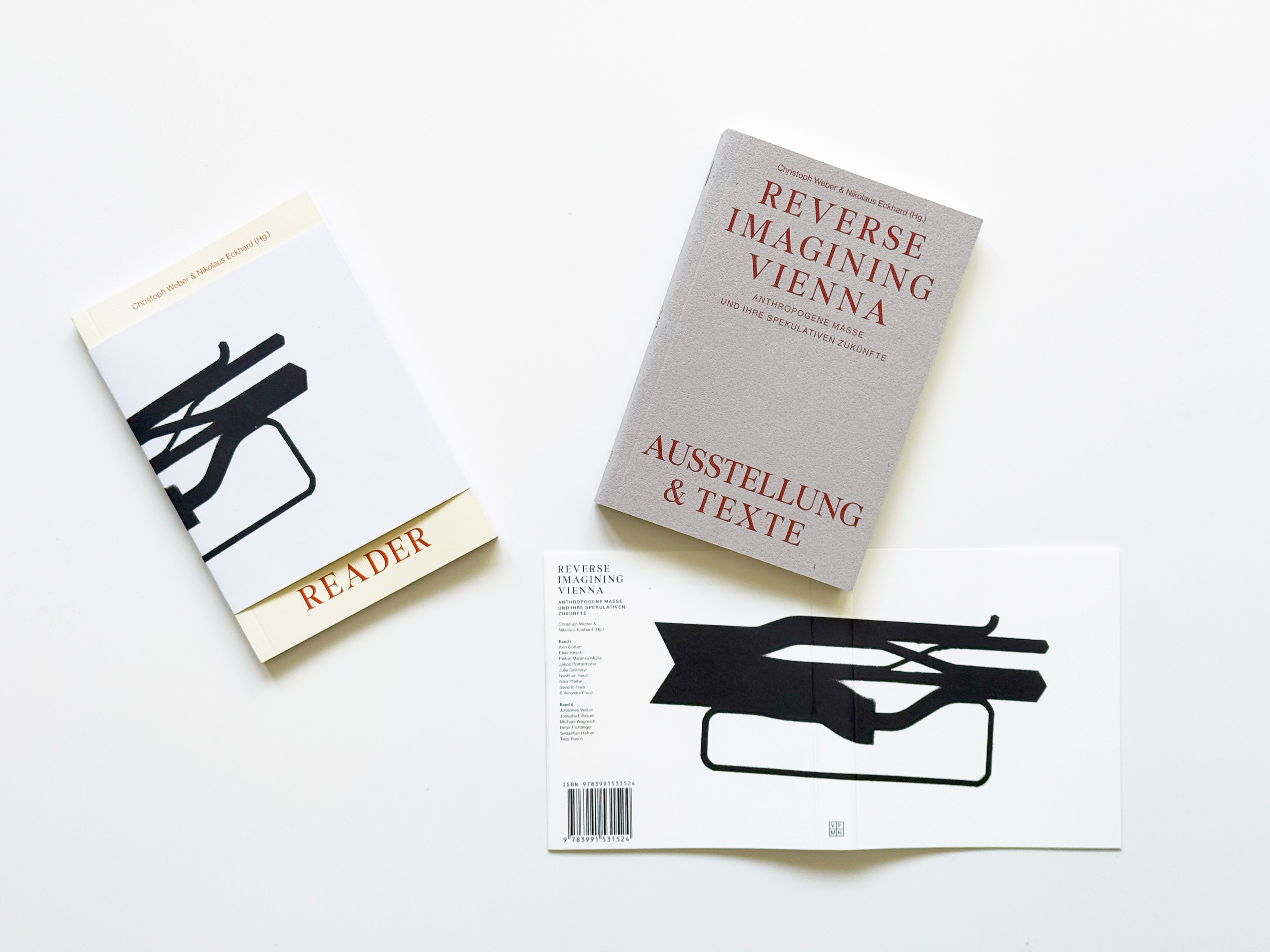
Reverse Imagining Vienna
Christoph Weber, Nikolaus Eckhard (ed.)
Verlag für Moderne Kunst, Wien, 2025
OPEN ACCESS - DOWNLOAD (ONLY GERMAN):
Christoph Weber’s four sculptural contributions:
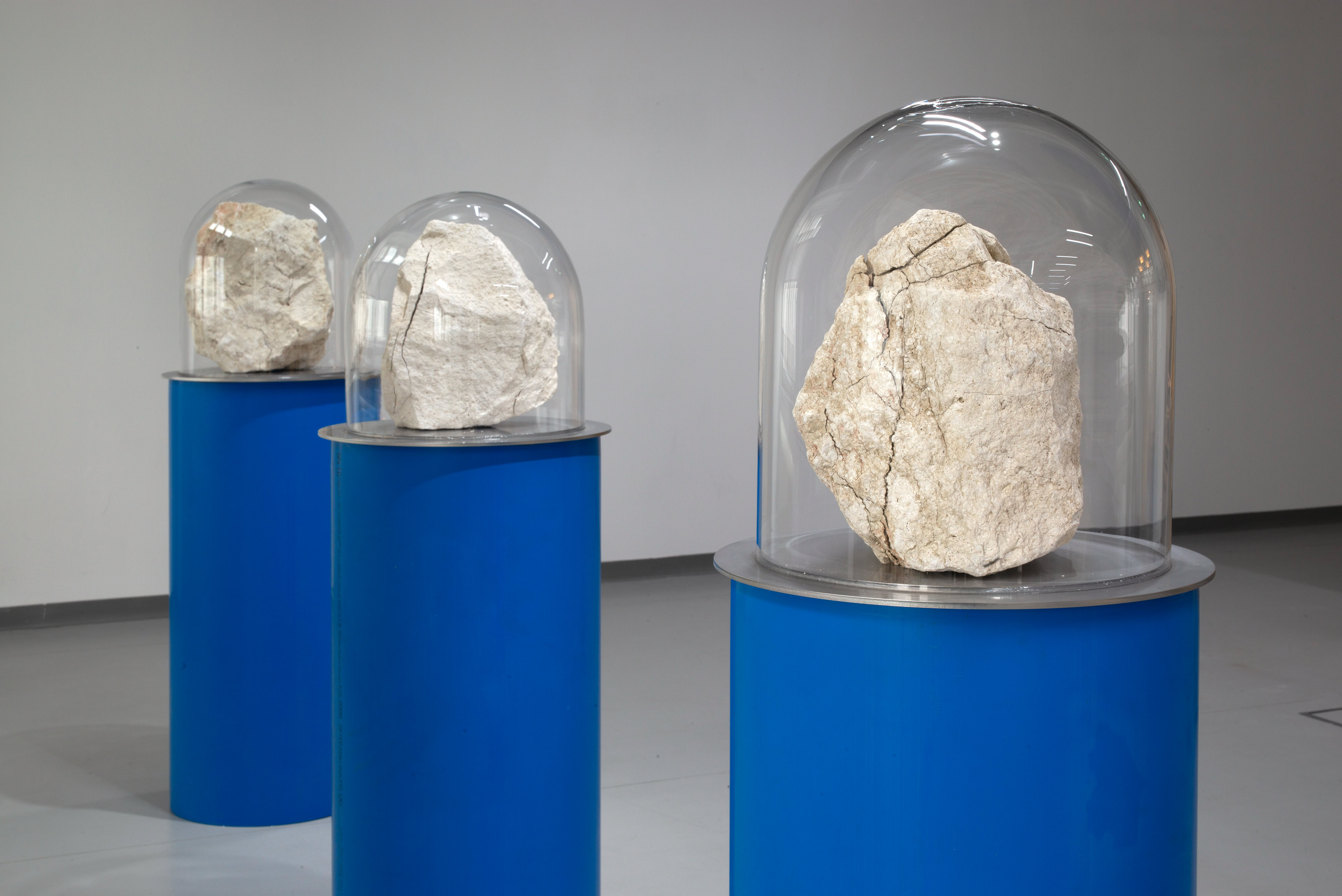
Limestone carcass (burnt limestone, Mannersdorf, quarry of cement industry), air proof glass lintel,
stainless steel, PP rainwater pipe
22.2 kg CaO & 13 kg CO2 emissions, 130 x 43 x 43 cm
10.6 kg CaO & 6.4 kg CO2 emissions, 125 x 43 x 43 cm
16.3 kg CaO & 9.1 kg CO2 emissions, 130 x 43 x 43 cm
For the Burnt Future Past series, limestone chunks were fired at 900° C for around 40 hours. (Traditional lime production) Limestone, which was formed in Mannersdorf am Leithagebirge 16 - 14 million years ago from red calcareous algae and shells, is therefore of organic origin and has a high proportion of bound CO2 , which is released during the firing process. Up to 40% of the weight of the stone chunks, also known as calcium carbonate (CaCO3), escapes in the form of CO2 emissions. The limestone initially retains its shape, but deep cracks appear and most of the color has escaped. This quicklime carcass (CaO) is thirsty for water and disintegrates into small pieces within a few days if it is able to extract moisture from the air. In the absence of air, however, the form remains intact and the burnt lime could be slaked at a later date.
The work addresses the effects of burning fossil fuels and materials and the need to protect the lithosphere. Several thousand tons of limestone are blasted out of the Leitha Mountains every day for cement production, fired at 1450° C with the addition of clay to form cement clinker and finally ground into cement. Limestone extraction represents one of the largest mass movements in industrial processing, the effects on biodiversity are serious and the CO2 emissions of the cement industry amount to around 7% of global CO2 emissions.
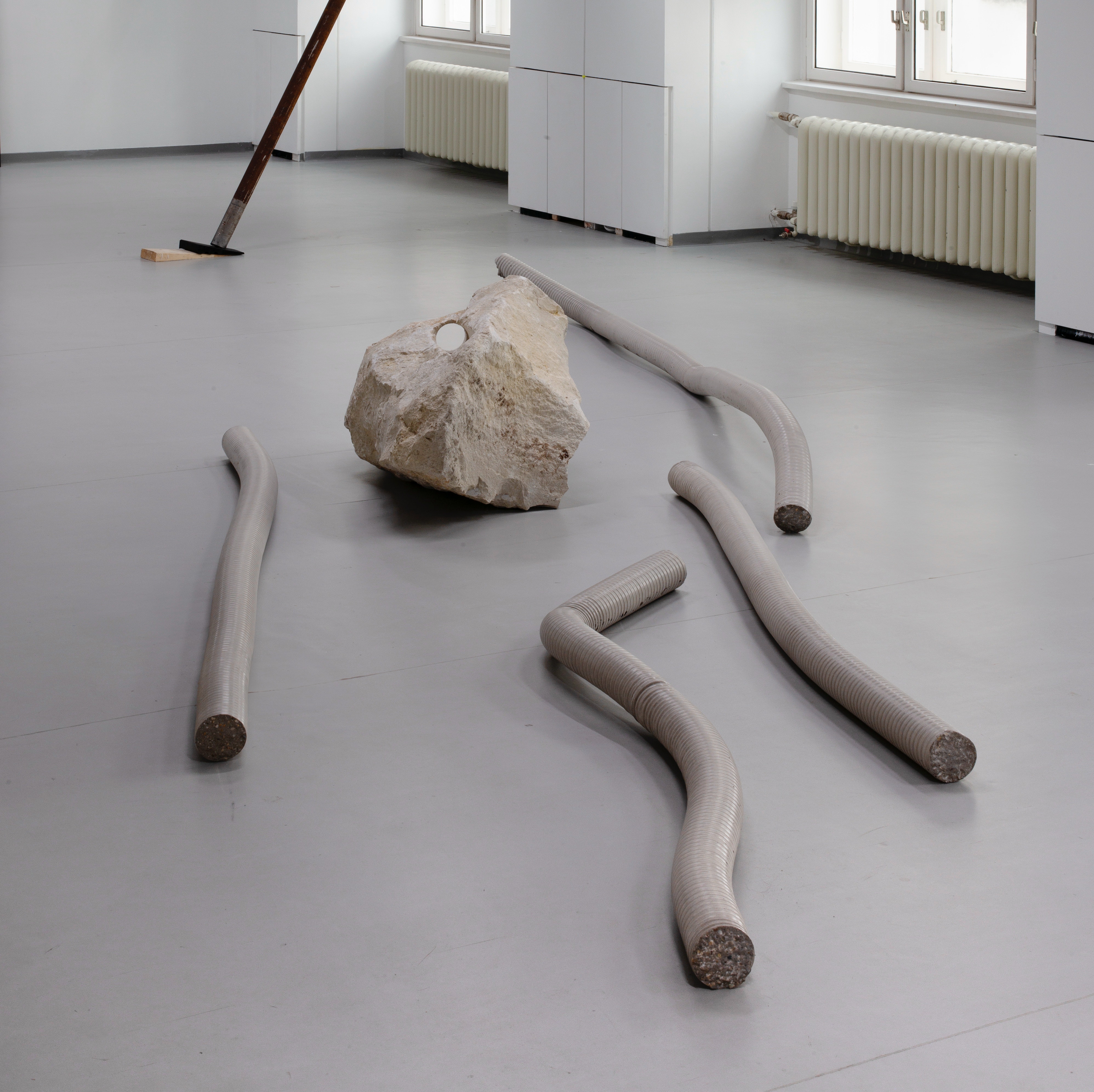
Mannersdorf limestone chunk with drilled hole, concrete
Overall dimensions approx. (H)64 x 650 x 200 cm
In Voracious Flux, a formal connection between extraction and material flow is initially established by matching the diameter of the borehole and the thickness of the concrete worm. The hose used for the extraction of cement and now concreted into oversized worms can be read as a voracious flow of material in extractivist societies. Several thousand tons of limestone are blasted out of the Leitha Mountains every day for cement production, fired at 1450° C with the addition of clay to form cement clinker and finally ground into cement. Limestone extraction represents one of the largest mass movements in industrial processing, the effects on biodiversity are serious and the CO2 emissions of the cement industry amount to around 7% of global CO2 emissions.
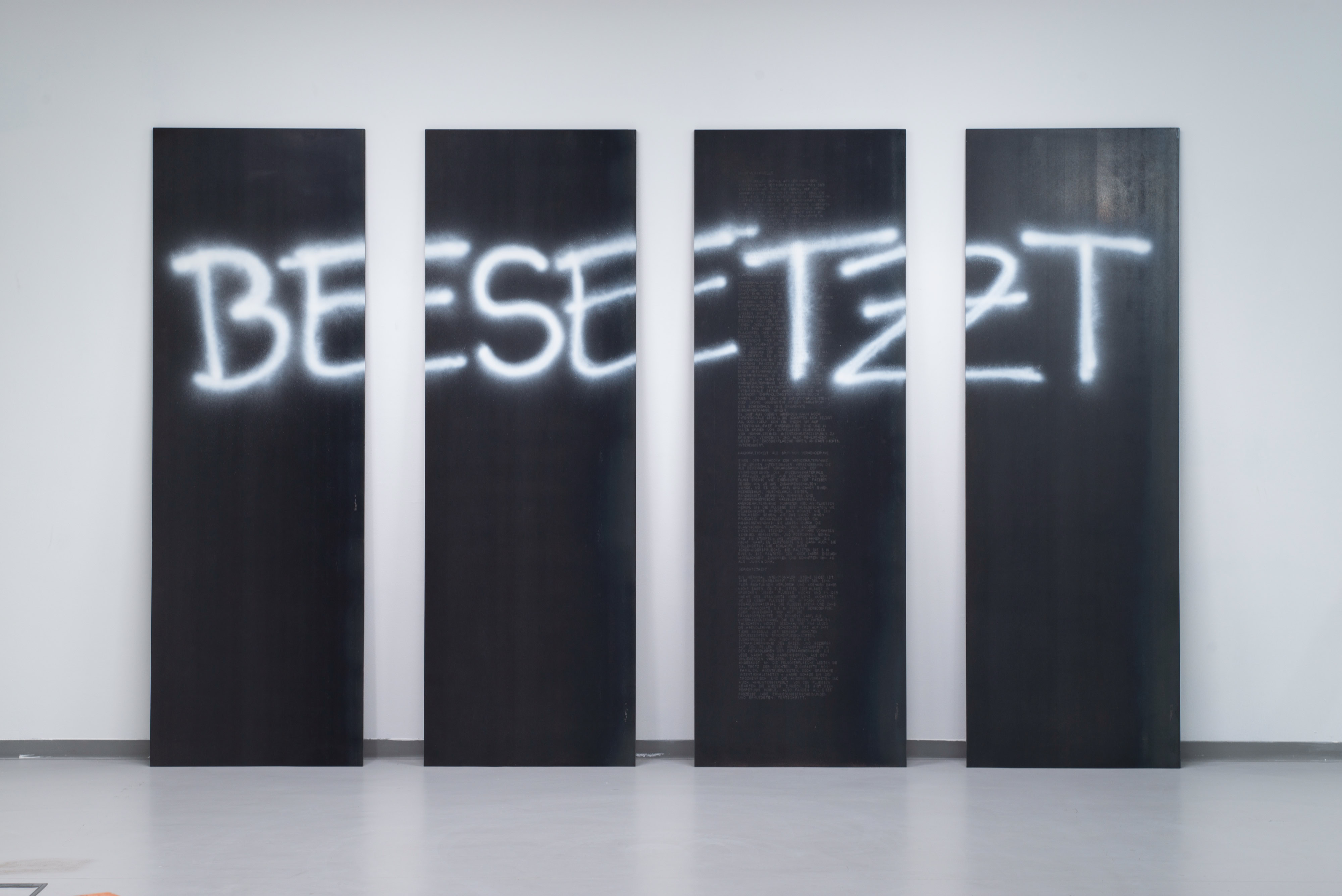
(referring to Julia Grillmayr and Ann Cotten)
Steel, spray paint, hammered text
Four 15 mm thick steel plates, each measuring 220 x 73 cm
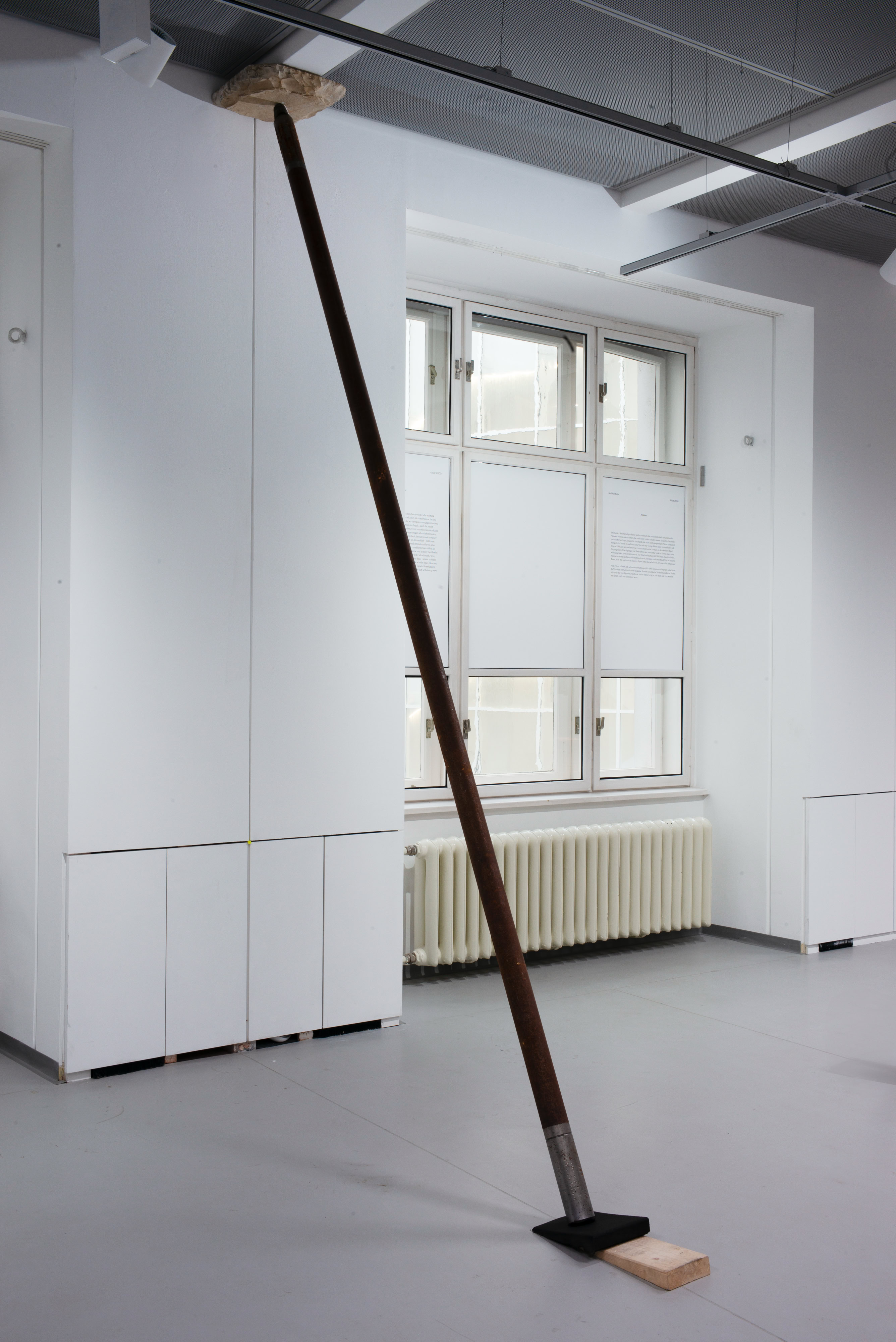
Solnhofen limestone slab from the generally accessible floor area of the investigated Gründerzeit house, steel rod (drill extension for extraction blast holes in the Mannersdorf limestone quarry), rubber wedge, wooden wedge
Overall dimensions approx. (H)374 x 210 x 40 cm
support connects the concrete of the bridge with the floor slabs of the house - the Mannersdorf limestone from cement production with the Solnhofen slab limestone from southern Germany. In Fiston Mwanza Mujila’s text about the Gründerzeithaus, Favoritenstraße is torn into several sections by torrential rain in the year 2436. “Only the paved sidewalks (supported by long iron bars) are still there.” The work refers to this and clamps a floor slab from the Gründerzeit house with a used steel rod from the quarry in Mannersdorf from below against a beam and a wall in the exhibition space. The rod is an extension for the drill used to drill holes 10 cm thick and up to 20 m deep into the limestone mountain, into which the explosives for the extraction are placed.
The gesture of pressing also refers to the other typical use of Solnhofen slab limestone - lithography.